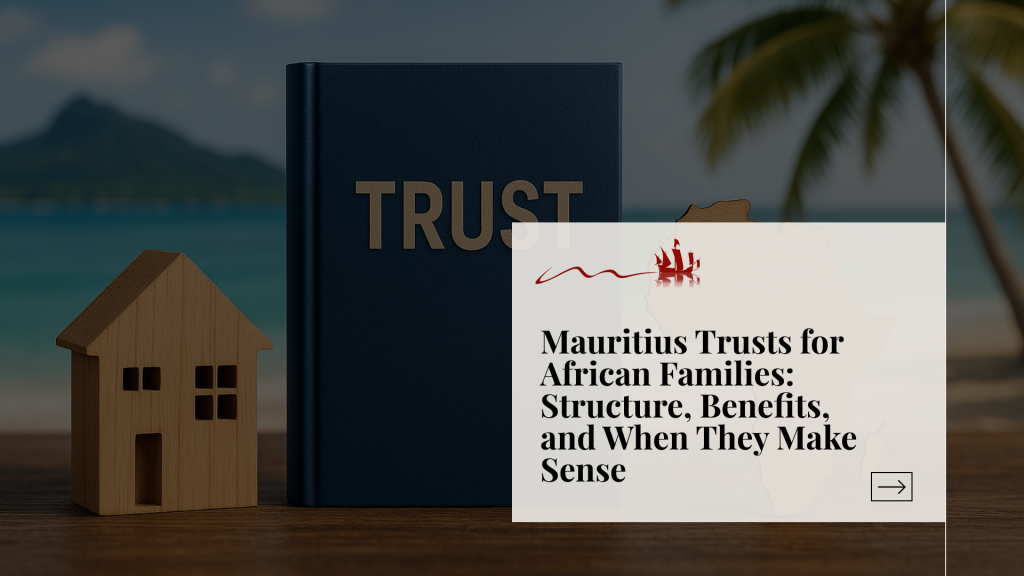
For many cross-border families, a well-designed trust can be the “central filing cabinet” of an estate plan—holding investments, governance rules, and succession instructions in one place. When exploring offshore trust structures for asset protection and legacy planning, Mauritius is often shortlisted because it combines a mature financial-services ecosystem with a legal framework built for international families.
This guide explains how a Mauritius trust typically works, what problems it can solve for African families with multi-jurisdiction wealth, and the practical situations where it makes sense (and where it doesn’t). The goal is clarity: what you can structure, what you can reasonably expect, and what to review with your advisers before committing.
Why Mauritius is frequently considered in African estate planning
African families increasingly hold assets and family members across several jurisdictions—home country businesses, regional property, offshore portfolios, and heirs studying or working abroad. A trust can provide continuity when laws, currencies, and family circumstances change.
Mauritius is commonly considered because it has a long-standing international finance sector and a trust regime oriented toward non-resident settlors and beneficiaries. For background on the regulator and the broader framework that supports financial services, see the Mauritius Financial Services Commission (FSC) official website.
What a Mauritius trust is (in plain English)
A trust is a legal relationship where assets are transferred by a settlor to a trustee to hold and manage for the benefit of beneficiaries, according to written rules in a trust deed. The trustee becomes the legal owner of the trust assets, but must act for the beneficiaries’ benefit and in line with the trust deed and applicable law.
Key parties and roles
- Settlor: The person (or entity) that contributes assets and sets the trust’s rules.
- Trustee: A professional or corporate trustee responsible for administration, investment oversight (if mandated), recordkeeping, and distributions.
- Beneficiaries: Family members and/or classes of beneficiaries (e.g., “children and remoter issue”).
- Protector (optional but common): A person or committee with consent/veto powers over key trustee decisions (e.g., changing trustees, major distributions).
- Investment adviser / family office (optional): Provides investment direction where the trust deed allows it.
Common trust types used by international families
- Discretionary trust: The trustee decides when and how much to distribute among a defined group, guided by the trust deed and a letter of wishes.
- Fixed-interest trust: Beneficiaries have defined entitlements (e.g., income to one person, capital to others).
- Purpose trust: Used for specific purposes (e.g., holding shares of a private company) where permitted and appropriately drafted.
Practical takeaway: A trust is less about “hiding assets” and more about creating a rules-based governance system that survives death, incapacity, and family transitions.
How Mauritius trusts can fit African family wealth
When people search for “Mauritius trusts African families,” they are usually trying to solve one (or several) of these estate-planning challenges:
- Succession complexity: Multiple heirs, blended families, minors, or heirs living in different countries.
- Business continuity: Keeping operating companies stable while family members transition leadership.
- Asset protection: Reducing exposure to personal disputes, forced sales, or fragmented ownership (always within the bounds of law and proper structuring).
- Confidentiality and governance: Consolidated reporting and decision-making protocols.
- Cross-border administration: A single trustee and trust deed coordinating assets held in multiple jurisdictions.
Core benefits (and what they really mean)
1) Continuity across generations
Unlike a will (which typically transfers assets on death), a trust can be designed to operate through life events: incapacity, divorce, relocation, and death. This can help prevent “freeze and fight” scenarios where estates become stuck in probate processes or family disputes.
2) Clear governance for distributions
Discretionary trusts can be structured to fund education, housing, medical needs, entrepreneurship, or philanthropic objectives based on defined criteria. A well-drafted letter of wishes can guide the trustee without becoming rigid.
3) Consolidated ownership for complex assets
Trusts are often used to hold shares in family holding companies, investment portfolios, or a mix of offshore and onshore assets. The goal is to reduce fragmentation (e.g., many heirs each owning small stakes) and to maintain consistent voting and dividend policies.
4) Risk management and creditor considerations
Asset protection is often cited, but it is not a guarantee and must never be used to defeat legitimate creditor claims. The strength of protection depends on timing (planning early), the settlor’s solvency, the drafting, and the relevant laws in all connected jurisdictions.
5) Potential for cleaner cross-border compliance
For globally mobile families, good trust administration can improve recordkeeping and reporting—especially where automatic exchange of information may apply. For a general overview of how cross-border tax transparency works, see the OECD Common Reporting Standard (CRS) framework.
When a Mauritius trust makes sense (and when it doesn’t)
Situations where it often makes sense
- Multi-jurisdiction families: Beneficiaries in different countries, or assets held across several legal systems.
- Significant or “lumpy” assets: A concentrated family business, large investment portfolio, or meaningful real estate exposure.
- Blended families: Balancing a surviving spouse’s lifestyle with children’s longer-term inheritance.
- Minor beneficiaries: Structuring education, maintenance, and staged access to capital.
- Succession planning for entrepreneurs: Avoiding rushed share transfers, deadlocks, or operational disruption.
Situations where it may not be the right tool
- Simple estates: One jurisdiction, few assets, straightforward heirs—often better served by updated wills and basic planning.
- Need for direct control: If you are unwilling to cede legal ownership to trustees (even with protector rights), the structure may feel restrictive.
- Unresolved tax residency issues: If family members’ residency and tax profiles are unclear, the structure can create surprises.
- Short timelines: Trusts are best established well before disputes, creditor pressure, or major litigation risk.
How a typical structure is built
Step 1: Define objectives and beneficiaries
Start with the real-world objectives: education funding, maintaining a spouse’s lifestyle, preserving a family enterprise, supporting dependants, philanthropy, or ring-fencing risky ventures. Then define beneficiaries carefully (named individuals and/or classes) and decide who should be excluded.
Step 2: Choose the trustee model and governance
Governance is where most value is created (or lost). Many families use:
- Corporate trustee for continuity and professional administration.
- Protector to add a family “check and balance.”
- Family governance documents (e.g., a family charter) to align expectations beyond the legal deed.
Step 3: Draft the trust deed and supporting documents
High-quality drafting is essential. The deed typically covers trustee powers, investment powers, distribution rules, appointment/removal mechanisms, and reporting obligations. A letter of wishes can communicate softer preferences such as education philosophy or entrepreneurship support, while allowing discretion.
Step 4: Fund the trust
Funding can include cash, listed securities, shares in holding companies, or other assets. Transfer mechanics and local restrictions matter—especially where exchange controls, approvals, or local conveyancing rules apply.
Step 5: Ongoing administration and reviews
A trust is not “set and forget.” Regular reviews should consider changes in family circumstances (marriages, divorces, births), asset composition, tax residency, reporting regimes, and the performance of service providers.
Tax and reporting: the conversation to have early
Tax treatment of trusts is highly dependent on the tax residency and status of the settlor, trustees, beneficiaries, and sometimes underlying companies—plus where assets are located and where income arises. Even if a trust is established in Mauritius, African home-country rules may still attribute income, require reporting, or impose taxation at the beneficiary level.
Practically, this means families should treat tax and reporting as design inputs, not afterthoughts: determine who is tax resident where, what information will be reported under applicable regimes, and how distributions will be documented.
Costs, timelines, and practical trade-offs
Expect professional fees to include: establishment, legal drafting, trustee onboarding and due diligence, and ongoing annual trustee and administration costs. Timelines vary depending on complexity, asset transfers, and banking or brokerage onboarding. The trade-off is that higher-quality governance and administration generally reduces future disputes and friction.
Common pitfalls (and how to avoid them)
- Over-promising asset protection: Trusts should be built for long-term governance, not as a last-minute shield.
- Ignoring local law interaction: Forced heirship, matrimonial property regimes, or exchange controls can impact outcomes.
- Weak governance: Without clear protector powers, succession planning for the protector, and decision protocols, family tension can rise.
- Poor documentation: Undocumented loans, informal distributions, and missing resolutions create tax and compliance risk.
FAQs
Are Mauritius trusts only for ultra-wealthy families?
Not necessarily, but they are most cost-effective when there is meaningful complexity—multiple jurisdictions, a sizeable portfolio, a business, or a need for structured governance. For smaller, simple estates, a strong will and local planning may be sufficient.
Can a family still influence decisions after setting up the trust?
Yes, through the trust deed design (distribution standards, investment powers) and governance tools such as a protector, an investment adviser appointment, and a letter of wishes. However, the trustee must retain enough discretion and independence to properly function as trustee.
Does a trust avoid tax automatically?
No. Tax outcomes depend on facts and on the tax rules of all relevant jurisdictions. A trust can improve planning and governance, but it does not “switch off” tax obligations or reporting.
How does a trust help with family business succession?
A trust can hold shares through a holding structure, set voting and distribution policies, and define who can benefit from dividends or capital—reducing the risk of fragmented ownership among heirs and supporting a controlled leadership transition.
Conclusion: deciding if a Mauritius trust fits your family plan
Used well, Mauritius trusts African families can be a practical way to organise multi-country wealth, align heirs under a clear governance framework, and reduce the likelihood of disorderly succession. The best results come from matching the trust design to your family’s real objectives, then stress-testing it against tax residency, reporting, and the jurisdictions where assets sit.
If you are weighing trust structures alongside other estate and holding options, it is worth comparing them with broader tax-efficient wealth structuring strategies so that control, compliance, and long-term costs are aligned from day one.